How to Match Your Wedding Flowers to Your Venue
There's a specific kind of beautiful floral design that doesn't quite work — where every element is technically well-done but something feels slightly off. A lot of the time, the issue isn't the flowers. It's that the flowers weren't designed for the space.
Matching your florals to your venue isn't about being predictable. It's about understanding what your environment already brings to the table and making design decisions that work with that rather than fight it.
Why This Matters More Than Most Couples Expect
Your venue is the visual context for everything else. The color of the walls, the quality of the light, the texture of the surfaces, the scale of the ceilings — all of it shapes how your flowers will read in person and in photos.
A dramatic, towering centerpiece in a low-ceilinged barn dining room creates a feeling of crowding rather than grandeur. A delicate, minimal arrangement on a long stone table in a vast historic ballroom disappears. Scale, texture, and palette need to be calibrated to the space they're in.
The good news is that once you understand the character of your venue, the direction for your flowers gets a lot clearer.
Historic Estate and Mansion Venues
Western Massachusetts and Connecticut have a remarkable number of historic estate properties — Federal-style houses, Georgian manor homes, Gilded Age summer residences. These spaces come with their own strong visual language: high ceilings, formal proportions, ornate architectural detailing, natural materials like marble, plaster, and wide-plank wood.
Flowers that work here tend to be classical in feeling. Structured, full arrangements in compotes or urn-style vessels. A palette that harmonizes with the existing architecture rather than competing with it. Elegant and abundant rather than wild and loose.
That doesn't mean you can't do something unexpected in a historic space — contrast can be incredibly effective. But the base note needs to acknowledge where you are.
Barn and Farm Venues
Barn weddings are still enormously popular across Western MA and CT, and they're a design environment with a very specific character: natural wood, ambient light, exposed beams, an organic, unpretentious aesthetic.
Overly formal or precisely structured florals can feel incongruous in a barn setting. What tends to work beautifully is arrangements with movement and texture — garden-style designs with mixed blooms, trailing greenery, dried grasses, and seasonal elements that feel like they belong in a landscape. Vessels that reference nature: terracotta, wood, simple glass.
The Pioneer Valley, the Berkshires, and Western Connecticut have incredible farm venues that lend themselves to this approach. When we're designing for a barn, we're often leaning into the seasonal local palette hard — whatever is growing nearby and in bloom on that date.
Outdoor Ceremony Spaces
Outdoor ceremonies give you the most dynamic visual background of any setting — natural light, actual landscape, often trees or hills or water. They also give you the least control over what the environment looks like on any given day.
Designing outdoor ceremony florals means designing for movement (because there will be wind), for natural light conditions (which read very differently than interior light), and for scale (because nature is large, and your arrangements need to hold their own in a wide-open space).
Arches and ceremony structures tend to read better larger than most couples initially envision. A small floral arch in front of an open landscape can look underwhelming in photos. When we're building ceremony structures for outdoor spaces in Western MA, we're usually thinking in terms of visual impact from 30 feet away — because that's where most of the guests will be watching from.
Modern and Contemporary Spaces
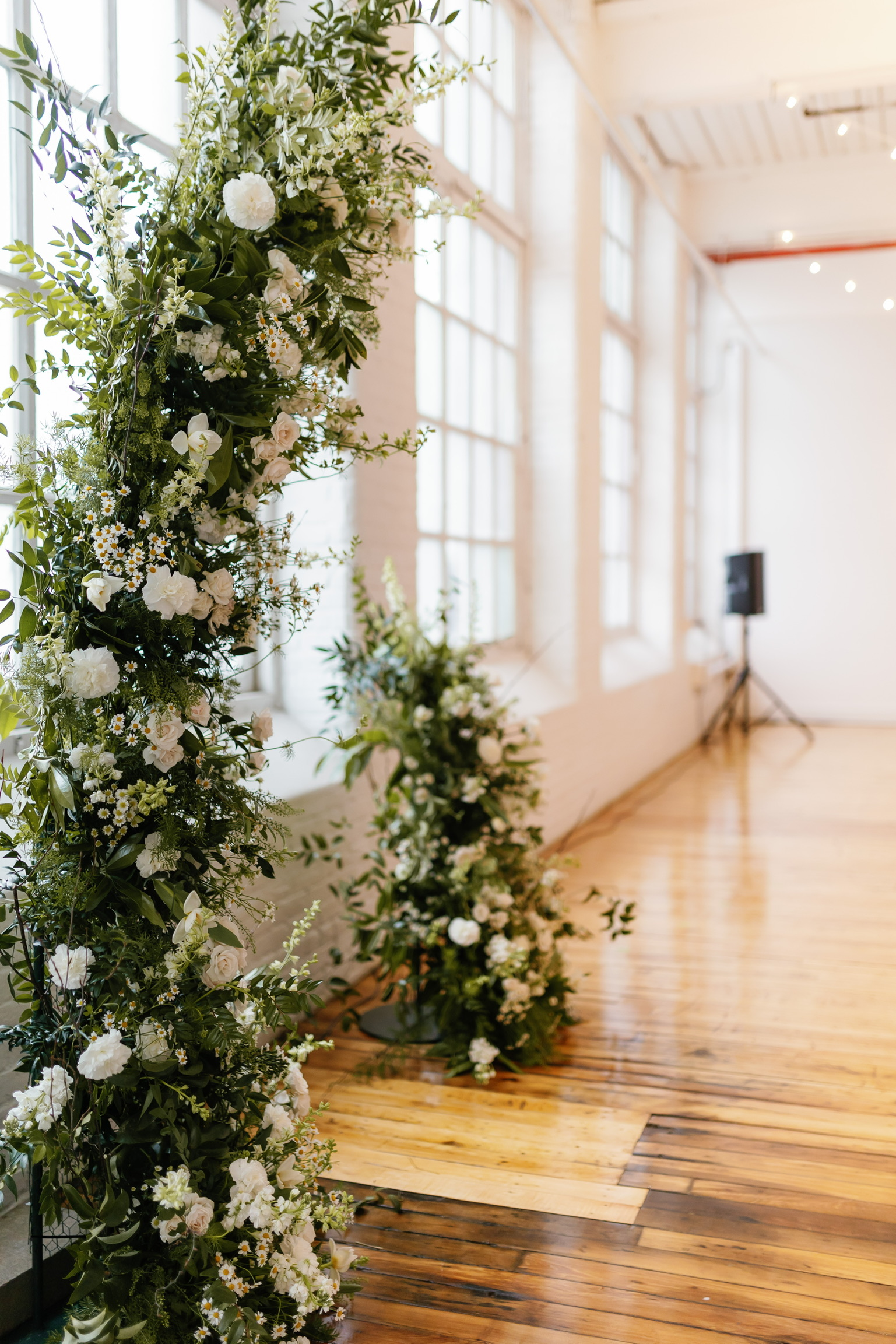
More contemporary venues — converted industrial spaces, modern art-forward properties, minimalist event spaces — call for a different design approach entirely. Clean lines, sculptural arrangements, restrained color palettes, and an appreciation for negative space tend to work better here than lush, overflowing English-garden style arrangements.
This is where greenery-forward design, single-variety arrangements, or architectural blooms like protea, anthurium, and calla lilies can really sing. The flowers become part of a modern aesthetic rather than decoration added onto it.
How Light Affects Everything
One thing that catches couples off guard: the same flower looks meaningfully different under different lighting conditions. A blush garden rose in warm afternoon outdoor light appears warm and peachy. Under cool indoor fluorescents, the same flower reads pinkish-gray. Under candlelight and Edison bulbs (common in barn venues), it goes warm and romantic.
When you're planning your palette, tell your florist what kind of light your venue has and when your reception takes place. Evening receptions under warm artificial light call for a different palette than afternoon outdoor ceremonies in direct sun.
We design for weddings at venues throughout Western Massachusetts and Connecticut — historic estates, farm properties, outdoor venues, and everything in between. See what we've created →
Two related guides worth your time: what's blooming in each New England season and our wedding centerpiece guide.
Written by Kristina, founder of Evergreen Events — designing wedding florals across Western Massachusetts and Connecticut.