Seasonal Wedding Flowers in New England: What's Blooming When
There's a version of wedding planning where you find a photo of a flower you love, fall completely in love with it, and then find out two weeks before your wedding that it won't be available in October in New England at anything close to a reasonable price. It happens more often than you'd think.
The good news is that once you understand what's in season for your region and your date, a lot of the decision-making gets easier — and often, cheaper.
Why Seasonality Matters More Than You Think
Flowers grown in their natural season are better in almost every measurable way. They're more robust, they hold longer, their colors are richer, and they arrive from growers in better condition. When they're in season, they're also more widely available, which keeps the cost down.
Out-of-season flowers have to be grown in climate-controlled greenhouses, often imported from further away, and they're more expensive at every step. They also tend to be more fragile by the time they reach us. It's not that out-of-season flowers are impossible — it's that they cost more and perform less, which is a bad trade.
Here's what New England looks like, season by season.
Spring Weddings (May–June)
Spring is one of the most abundant times of year for wedding flowers in Western Massachusetts and Connecticut. The options are genuinely gorgeous.
What's in season: Peonies, ranunculus, tulips, lilac (if you're early enough — lilac is fleeting), garden roses, sweet peas, anemones, fritillaria, muscari, narcissus, and the early dahlias.
Peonies are the standout spring bloom for our region. They're full, fragrant, and photograph beautifully — and June is their peak. If peonies are on your list, a May or early June wedding is your best window. A September bride paying for peonies is paying a premium for something that's traveled far and won't be quite the same.
The challenge with spring weddings is weather variability. Western MA in May can be warm and gorgeous or cold and rainy within the same week. For outdoor ceremony flowers, we always plan for temperature and wind, not just color palette.
Summer Weddings (July–August)
Summer is when the full range opens up. Dahlias begin in earnest, garden roses are abundant, and the warm-season flowers hit their stride.
What's in season: Dahlias (café au lait, dinner plate varieties), sunflowers, zinnias, lisianthus, lavender, sweet William, yarrow, statice, scabiosa, celosia, and an enormous range of locally-grown fillers and foliage.
Summer is also the easiest time to incorporate locally-sourced flowers, which matters both for sustainability and for quality. We work with farms in the Pioneer Valley and Western Connecticut that grow exceptional stems — and in summer, there's real variety available on the local market.
One practical note: summer heat is hard on flowers. Outdoor ceremonies in August heat require extra care in conditioning, timing, and transport. It's not a deal-breaker, but it's something we plan around on every summer wedding.
Fall Weddings (September–October)
Fall is peak wedding season in New England, and for good reason. The foliage, the light, the temperatures — it all cooperates beautifully. Florally, it's also exceptional.
What's in season: Dahlias (still going strong through October), chrysanthemums, marigolds, cosmos, amaranth, ornamental kale, seasonal branches, bittersweet, late-season garden roses, dried grasses, and an enormous range of textural elements that look stunning against fall foliage.
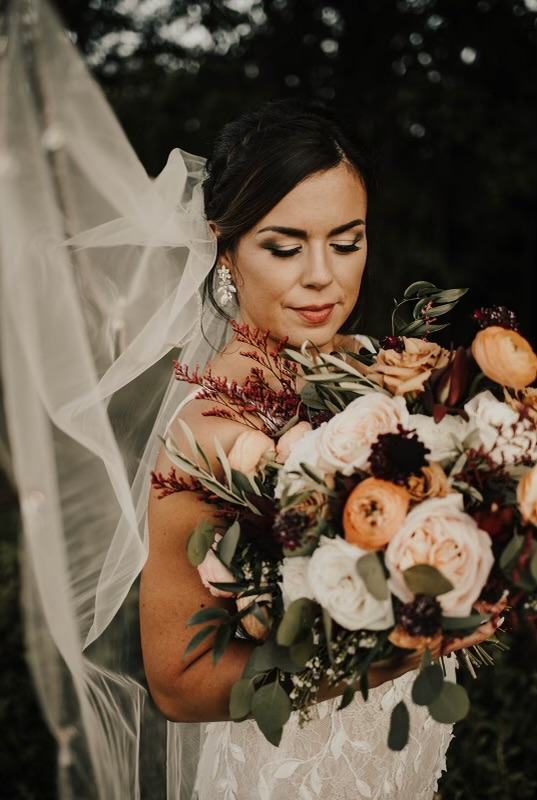
Fall is when we lean into texture and depth. Deep burgundies, burnt oranges, terracotta, chocolate browns, blush, and cream all work beautifully together. The natural palette New England provides in October is, honestly, hard to compete with — the best floral design in fall often works with the environment rather than against it.
Winter Weddings (November–February)
Winter weddings in Western MA and CT are underrated. Done well, they're incredibly romantic and visually distinctive.
What's in season: Amaryllis, hellebores, anemones (winter is prime anemone time), paperwhites, evergreen foliage, cedar, pine, eucalyptus, ranunculus, and early spring bulbs forced into bloom.
The palette shifts toward deep, saturated tones — burgundy, navy, forest green, ivory, white — or goes fully minimal and architectural with all-white arrangements and greenery. Winter flowers tend to have structure that holds beautifully in the cold, which actually makes them easier to work with for cold-weather venues.
The Bottom Line on Seasonality
You don't need to build your entire vision around what's in season. But understanding it means you can make smarter choices — spending on blooms that will look their best on your date and saving on the places where the seasonal option is genuinely just as good.
When you meet with us for a consultation, one of the first things we'll talk about is your date and your venue — because both determine what's actually going to look best on your wedding day.
Explore our approach to floral design →
For more on turning the season into a design, take a look at our bridal bouquet style guide and matching your flowers to your venue.
Written by Kristina, founder of Evergreen Events — designing wedding florals across Western Massachusetts and Connecticut.